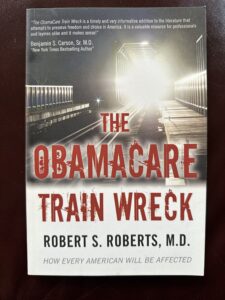
ObamaCare is a train wreck. I wrote a book about it by the same name in 2014. Since then, it has only gotten worse. Costs continue to rise and the Democrats keep pushing more government subsidies to make it more affordable. This is throwing good money after bad. What can we do about it?
John C. Goodman, healthcare economist, has some suggestions. He says that Congress is making three missteps to fixing the problem:
- On the buyer side, we have been trying to force people to buy insurance they would never buy with their own money.
- On the seller side, we have been trying to force insurers to enroll people they do not want to enroll.
- On both sides of the market, we have created inverse incentives that cause costs to be higher and quality lower than would otherwise have been the case.
Goodman explains: “The difficulty of trying to force people to buy something they don’t want to buy became evident in year one. Fast food restaurant chains were forced to offer their employees insurance that was so comprehensive, we were led to believe it would cover the cost of a million-dollar premature baby. For self-coverage, employees had to pay 9.6 percent of wages, and out-of-pocket spending could be as high as $6,350. To cover a spouse and children, workers were asked to pay the full premium.”
The problem is people have no interest in coverage for low-probability medical events that could cost a million dollars. They figure they’ll never happen and if they do someone else will end up paying the bill.
Goodman tells us In the years that followed, Obamacare insurance became increasingly unattractive. Average premiums for marketplace plans have grown twice as fast as they have in a typical employer plan. Last year, the average deductible in the most commonly selected exchange plan was $4,572, more than twice as high as in an average employer plan ($1,787). The maximum out-of-pocket expense in the average exchange plan was also more than twice as high ($9,450) as in the average employer plan ($4,750).
The current controversy concerns a second tier of federal tax subsidies for marketplace insurance. Although created during the COVID-19 era, the real reason for these enhanced subsidies was not COVID-19. The unsubsidized part of the market was in a death spiral. The healthy were dropping out in droves. As the pool became sicker, premiums kept rising to cover the higher cost.
What’s the solution?
Let people buy the insurance they want! KFF (formerly Kaiser) says that premiums could be cut in half for most people if they could buy the type of insurance that was generally available before there was Obamacare.
What if they choose a plan that fails to cover an unexpected problem (like substance abuse) that is required coverage in the Obamacare exchanges? Let them immediately switch to a silver exchange plan that meets that need. Keep Obamacare insurance in place for people who need it, when they need it. But let most families have cheaper and better insurance if it meets their current needs.
On the seller side, it should come as no surprise that insurers are not anxious to enroll people whose premium payments are well below the expected cost of their care. To solve this problem, look at the Medicare Advantage (MA) program. This is the only place in our health care system where doctors who discover a change in a patient’s condition (say the emergence of cancer) can send that information to the insurer (in this case, Medicare) and receive a higher premium payment to cover the expected increase in treatment costs. The result is MA plans welcome patients with costly health problems – patients that insurers in other market try to avoid.
Lastly, Goodman tells us there are perverse incentives in some plans. Because subsidized premium payments are capped as a percent of the enrollee’s income, most enrollees bear no personal cost when they choose a more expensive health plan. The extra cost is paid by the taxpayers. And since enrollees are not price sensitive, insurers don’t really compete on price.
To solve this problem, consider the federal employees’ health benefits program (the one Congress gets to use!) The employer subsidy is a fixed amount, independent of the employee’s health plan selection. If the employee chooses a more expensive plan, the extra cost comes out of the employee’s pocket, not some other pocket. Because this system makes buyers price sensitive, insurers in this market compete on price and quality just like they do in other insurance markets.
These solutions are not that difficult to implement, but Congress has a problem: Democrats won’t admit that ObamaCare has a problem – because they created it! Like an alcoholic who can’t get help until he admits he has a problem, Democrats won’t work with Republicans to fix ObamaCare until they face up to the failures of the healthcare system they created.