Mattress Woes – Part II


In Part I of this series, we learned that your mattress may be the source of your pains, especially in your low back. A firmer and newer mattress may be the solution.

But there are other threats to your health in your mattress. In Part II we will discuss these other threats. Flora Zhao, writing in The Epoch Times, tells us many people with unexplained symptoms simply need to replace their mattress. What are these threats?

Dust Mites and Allergens

An old mattress not only compromises support for your body, but can also lead to other problems. For example, dust mites can thrive in an old mattress. Human skin renews itself constantly, shedding an average of 1.5 grams of dead skin cells each day. This amounts to roughly 1.1 pounds of skin flakes annually, most of which become “house dust.”

The continuous shedding and accumulation of skin cells in the environment is not a problem in and of itself. The real problem is that these skin cells serve as food for dust mites. Old mattresses often harbor large populations of these mites. They are microscopic, measuring about 0.4 millimeters in length, and invisible to the naked eye. They thrive in warm, humid conditions with ample food, which means mattresses are their ideal habitat.

Dust mites carry various allergens in their droppings, exoskeletons, and eggs. More than 20 known mite-related allergens can trigger allergic reactions and contribute to the development of atopic dermatitis. One study found that approximately half of U.S. households have dust allergen levels at or above the presumed allergy sensitization level (more than 2 micrograms per gram of dust). Dust mite allergens at levels exceeding 10 micrograms per gram (µg/g) of dust are considered likely to induce allergic symptoms. A study conducted on mattresses in a dormitory for hospital staff in Thailand showed that after nine months of regular use, the average dust mite allergen level in sponge-like polyurethane mattresses increased to 11.2 µg/g of dust. After 12 months, this level had doubled.

The type of mattress can also influence dust mite density. An early study conducted by Norwegian scientists on more than 100 mattresses found that foam mattresses were about three times more likely to harbor dust mite droppings than spring mattresses, and foam mattresses without covers were five times more likely to have them. Researchers in Brazil found that dust collected from the lower surface of mattresses was significantly more infested with dust mites than the upper surface—3.5 times more.

These microorganisms can cause a range of symptoms, including headache, fatigue, chest tightness, coughing, asthma, allergies, eye and nasal irritation, rashes, and muscle pain. For individuals with weakened immune systems or chronic lung disease, bacteria can infect the lungs, potentially leading to hypersensitivity pneumonitis. Bacterial growth in mattresses has also been linked with some cases of Sudden Infant Death Syndrome (SIDS).

Flame Retardants

Since the 1970s, regulations have mandated the addition of flame retardants to consumer products. These substances are known for their persistence, bioaccumulation, and toxicity. From 2004 to 2017, regulatory controls on these chemicals were gradually included in the Stockholm Convention, a global treaty that protects people from persistent organic pollutants. Today, many of the controversial flame retardants have been phased out in most countries.

However, households may still be using mattresses containing these potentially hazardous substances. Flame retardants typically constitute about 3 percent to 7 percent of the weight in polyurethane foam. Although the U.S. Consumer Product Safety Commission approved a petition in 2017 to stop requiring flame retardants, it will take years to eliminate these toxic substances from household environments.

A 2022 study showed that mattress covers were found to contain flame retardants despite certifications for the foam. In four newly purchased mattress covers tested by researchers, two contained more than 50 percent fiberglass—a common flame retardant used in mattresses—in the inner layers. The fiberglass fragments, ranging from 30 to 50 micrometers in diameter, could be inhaled into the nose, mouth, and throat. Some materials, like natural rubber and wool, are naturally flame-resistant. Opting for mattresses made from these materials can help minimize exposure to flame retardants.

In summary, your mattress may be the source of your back pain, your insomnia, headaches, fatigue, chest tightness, coughing, asthma, allergies, eye and nasal irritation, rashes, and muscle pain. Although mattress warranties may be for 20 years or more, replacing your mattress sooner may solve some of these problems.
Mattress Woes – Part I


Could your mattress be the source of your pain? For some people, the answer is Yes! Flora Zhao, writing in The Epoch Times, tells us many people with unexplained symptoms simply need to replace their mattress.

“A lot of people wake up in the morning, and they will have a stiff back or a sore back. That may be a sign that the mattress is getting older,” Bert Jacobson, regents professor of applied health and educational psychology at Oklahoma State University, told The Epoch Times.

Over the past two decades, Jacobson has led and participated in a series of studies on mattresses. He has identified a common phenomenon: When people switch to a new mattress, the symptoms that once troubled them often disappear. In his research, many individuals reported no longer experiencing stiffness and pain upon waking, feeling more refreshed, and having less psychological stress. He noted that people may not realize that all these discomforts are related to what they’re sleeping on.

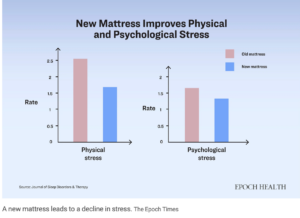
“The average age of a mattress is around 10 years old,” Jacobson said. In one of his earlier studies, 59 healthy participants who used the same mattresses for an average of 9.5 years reported mild sleep-related pain and compromised sleep quality. After switching to a new medium-firm mattress for four weeks, they experienced a 48 percent reduction in back pain, a 55 percent improvement in sleep quality, and an approximately 20 percent decrease in stress.

Another study involved participants whose mattresses had been in use for 11.3 years. They exhibited significant health improvements after switching to new mattresses. Their physical stress scores dropped from 2.57 to 1.73, their psychological stress decreased from 1.70 to 1.37, and they slept longer.

As an orthopedist, I have often recommended a new mattress for patients with low back pain. As a general rule, “Firmer is better.” Many people with low back pain will get better with a firmer mattress.

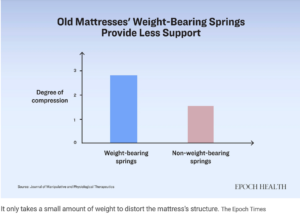
Recognizing that simply replacing a mattress can alleviate or eliminate pain and discomfort, Jacobson designed a study to examine the wear and tear of old mattresses, focusing on the most commonly used spring mattresses. He and his colleagues collected 32 old mattresses, the average age of which was nine years. By extracting and testing the weight-bearing springs from the center of the mattresses, as well as the non-weight-bearing springs from the head and foot, they found that although the mattresses appeared flat and the springs looked normal, the weight-bearing springs were weaker than the non-weight-bearing springs due to years of compression.

Specifically, when approximately 2.2 pounds of weight was applied to both types of springs, the weight-bearing springs were compressed by an average of 1.09 inches. In contrast, the non-weight-bearing springs were compressed by little more than half an inch, highlighting a significant difference.

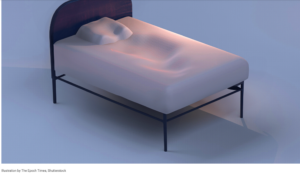
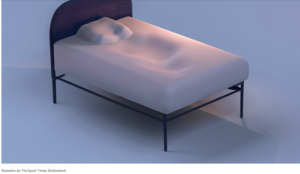
Some people believe that their mattresses, despite years of use, are still in good condition, but this is just an illusion. Jacobson explained that non-weight-bearing areas of the mattress can appear visually flat, and since a bedspread always covers them, the mattress may even look relatively new. However, even a small amount of weight can cause significant deformation in the weight-bearing springs, potentially compromising their original structural support. This can result in poor sleep posture and a decline in sleep quality.

(Note: There are other threats within old mattresses besides pain. For more on these see Part II of this series.)

Bias in Sponsored Clinical Trials


How reliable are the results of clinical trials of new drugs? That’s an important question and one that is getting the attention of researchers.

When a pharmaceutical company develops a new drug, they must first put it through a clinical trial to prove its efficacy and safety. That means patients volunteer to be “guinea pigs” to find out if a new medicine will help them. Only after extensive clinical trials can a new drug be accurately evaluated. Clinical trials are required for FDA approval and form the basis of all new pharmaceutical developments.

But how reliable are these clinical trials and do they have an inherent bias? Huey Freeman, writing for The Epoch Times, tells us of some recent research that suggests there may be bias in some of these trials. He says, “Drug studies sponsored by drug manufacturers tend to report higher drug efficacy than studies not sponsored by drug companies, a report published in the Journal of Political Economy on Oct. 7 found. The report found a “sponsorship effect” that tends to bias sponsored studies toward reporting higher drug efficacies. The author could not find differences in study design between those funded by drug companies and those not.

“Removing the sponsorship effect would reduce the difference in efficacy … by about 50 [percent],” Tamar Oostrom, an assistant professor of economics at Ohio State University, said in her paper.”

“This effect was larger than I expected,” Oostrom told The Epoch Times over email. “My results suggest that sponsored arms of trials should be discounted substantially.” She said that the difference in results between sponsored and unsponsored trials may be that “manufacturers are running multiple trials and selectively publishing those that are more favorable towards their drug.”

Her research analyzed the published papers of 509 trials and 1,215 treatment arms (groups of participants). Most of the trials were published after the drug gained approval from the U.S. Food and Drug Administration. About three-quarters of those examined were for antidepressants, with the remaining quarter for antipsychotic medications. “My paper is the first to examine the effect of financial sponsorship on outcomes by directly comparing a large set of trials in which the exact same arms are tested with differing financial interests,” Oostrom wrote.

There is an obvious incentive for pharmaceutical companies to try to influence the results of clinical trials. Trials in which the manufacturer’s drug does well are more likely to be published. Publications are then used to market the drug to physicians who in turn are more likely to prescribe the new drug.

As an example of bias, Oostrom presented the case of Effexor, an antidepressant introduced by Wyeth Pharmaceuticals in 1993. Over the following 15 years, Wyeth funded 14 randomized controlled trials comparing Effexor’s effectiveness with that of its rival, Prozac. In 12 of these trials, funded solely by Wyeth, Effexor was found to be more effective.

However, when Effexor and Prozac were compared with alternative funding, only one out of three trials found Effexor to be more effective. “Each of these trials is a double-blind RCT comparing the exact same two molecules and examining the same standard outcomes,” Oostrom wrote in her paper.

This research only looked at psychiatric drugs but the results and conclusions may well apply to other clinical trials, too. More research is needed to see if this same bias is present in other clinical trials.