Covid Lessons Learned


The month of March marked the 4th year anniversary of the Covid pandemic as it hit the United States. Who can forget when Vice President Mike Pence announced the White House’s “15 days to slow the spread” campaign? It was an unprecedented initiative by the federal government to begin lockdowns, school closings, and other sweeping measures to mitigate the spread of Covid-19, a novel coronavirus that came to us from China.

Four years later we can assess the damage done by those measures and evaluate their effectiveness in containing the virus. Unfortunately, the analysis is ugly. Dr. Scott Atlas, Stanford University Medical School professor, and Steve H. Henke, professor of applied economics at Johns Hopkins University, tell us the sordid truth in an article published in The Wall Street Journal. They say, “None of those policies were successful, and many were gravely damaging.”

They tell us the Covid health benefits of mandatory lockdowns were tiny. Lockdowns in the U.S. prevented between 4,000 and 16,000 Covid deaths. In an average year 37,000 Americans die from the flu, according to the Centers for Disease Control and Prevention. Lockdowns also failed to reduce infections more than a trivial amount, in part because people voluntarily alter their behavior when a bad bug is in the air. Coercive government policies generated few benefits—and massive costs.

Public-health agencies exacerbated the damage by failing to keep their heads and follow standard pandemic-management protocols. Before 2020, it was recognized that communities respond best to pandemics when government measures are only minimally disruptive. During Covid, however, officials junked that practice by green-lighting restrictive practices and intentionally stoking fear. That response overlaid enormous economic, social, educational and health harms on top of those caused by the virus.

Those harms are captured, in part, in excess deaths—the number beyond what would have been expected without a pandemic. Non-Covid excess deaths from lockdowns, the shutdown of non-Covid medical care, and societal panic are estimated at nearly 100,000 between April 2020 and at least the end of 2021. The number of lockdown and societal-disruption deaths since 2020 is likely around 400,000, as much as 100 times the number of Covid deaths the lockdowns prevented.

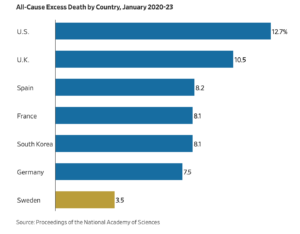
The best measure of health performance during the pandemic is all-cause excess mortality, which captures the overall number of deaths relative to the expected level, encompassing Covid and lockdown-related deaths. On this measure Sweden—which kept most schools open and avoided strict lockdown orders—outperformed nearly every country in the world.

A recent study published in the Proceedings of the National Academy of Sciences found that the U.S. “would have had 1.60 million fewer deaths if it had the performance of Sweden, 1.07 million fewer deaths if it had the performance of Finland, and 0.91 million fewer deaths if it had the performance of France.” In America, states that imposed prolonged lockdowns had no better health outcomes when measured by all-cause excess mortality than those that stayed open. While no quantifiable relationship between lockdown severity and a reduction in Covid health harms has been found, states with severe lockdowns suffered significantly worse economic outcomes.

What was the impact of closing hospitals and cutting off access to non-Covid healthcare?

The authors tell us, “Closing hospitals and cutting off access to non-Covid healthcare generated a fear of entering medical facilities. That was a profound mistake, as was encouraging the false belief that hospitals were too busy to treat people who needed care. Healthcare utilization rates were at low levels between 2020 and 2022. In spring 2020, nearly half of the nation’s some 650,000 chemotherapy patients didn’t get treatment, and 85% of living organ transplants weren’t completed. One study found that there were 35.6% fewer calls for cardiac emergencies after March 10, 2020, compared with the year prior. Emergency-room visits were down between 40% and 50%, according to an estimate in May 2020. That doubtless contributed to observed non-Covid excess deaths and may continue to do so, as Americans suffer from undetected cancers and other long-term conditions. Healthcare uptake is still lower than pre-pandemic levels.”
While school closings had no offsetting public-health benefits, the attendant isolation led to massive increases in psychiatric illness, self-harm, obesity and substance abuse. Healthy children were always at vanishingly small risk from Covid, and nearly all of them were infected at some point anyway, according to CDC data. Like a regressive tax, these harms were severest for lower-income and minority students.

Unfortunately, this experience has left many Americans wondering where to turn for honest, accurate information in a medical crisis. They have lost faith in our public-health institutions. It’s not clear how that faith can ever be restored.
Rejecting Wokeness in Medical Schools


If you follow this blog regularly, you know I’ve written several times about woke ideology infecting medical schools. (Woke Medical Education Update 2024) Today, we have good news – some in Congress are pushing back.

Greg Murphy and Stanley Goldfarb, both physicians, have come together to change the direction of this dangerous movement. Dr. Murphy is a practicing urologist and a North Carolina Congressman. Dr. Goldfarb is a nephrologist and chairman of Do No Harm. They write in The Wall Street Journal: “The ideology of “diversity, equity and inclusion” is dangerous everywhere, but especially in medical education. Its influence has become entrenched nationwide. Accrediting institutions are pushing all of America’s 158 accredited medical schools to train future physicians in political activism, wasting precious time and resources that could be spent on rigorous coursework and preparation for medical practice. The result will likely be future physicians less qualified to meet patients’ needs.”

They say to restore medical education to its life-saving mission, Congress should ensure that taxpayer dollars don’t fund its decline. One of them, Rep. Murphy, will introduce the Educate Act on Tuesday. It would eliminate all federal funding, including student loans, for medical schools that engage in the worst DEI practices. Schools would have to agree to the following:

• No racist teaching. Medical schools teach about “intersectionality,” “colonization” and “white supremacy” while promoting the idea that people are either “oppressors” or “oppressed.” These concepts push medical students to treat patients differently based on race, sex or “gender identity.” In 2021 two physicians proposed giving preferential treatment to “Black and Latinx heart failure patients” at Brigham and Women’s Hospital, a teaching hospital of Harvard Medical School. 

• No racial discrimination. Medical schools increasingly offer scholarships, classes and programming designed for—and sometimes available only to—students of specific races. This includes “affinity groups” students can join voluntarily, as well as classes that segregate students for the sake of learning. 

• No loyalty oaths. Medical schools routinely require applicants and faculty to write DEI statements as a condition of acceptance or employment. Such requirements violate freedom of speech and eviscerate merit. Schools reject candidates for not being “progressive” enough while choosing others for their devotion to DEI. 

• No DEI offices. Most medical schools have a department, team or office dedicated to DEI. These bureaucracies exist to spread a divisive ideology across campus, from the curriculum to extracurricular activities. 

They continue, “In addition to denying federal money to schools that engage in these practices, the Educate Act would prevent accrediting organizations, such as the Liaison Committee on Medical Education and the Association of American Medical Colleges, from requiring DEI education at medical schools.”

“Lawmakers and the public should recognize DEI for what it is: a dangerous and contagious philosophy. Until Congress takes action, this ideology will continue to corrupt the institutions that train physicians. Medicine and the people it’s meant to serve will suffer.”

Let’s be honest – no one cares about the color of the doctor’s skin! They only want to be sure he or she is well-trained and knowledgeable about their condition. If we lower the bar for minorities to get into medical school, what we’re really doing is denigrating the credentials of thousands of well-trained and talented minority physicians who got into medical school on the merits of their ability! Lowering the bar hurts them and their patients. It’s just not acceptable.


School Choice in Rural America

Regular readers of this blog know I sometime stray from the topic of healthcare to passionate issues of mine. One of those is school choice. School choice represents the solution to the problem of poor education, especially in low-income families who can’t afford better. School choice is the path to upward mobility for these children who need a good education to get ahead in this world.

We tend to think of this problem as an inner-city phenomenon, where poor public city schools trap low-income minority children in a never-ending spiral that keeps them impoverished – and that’s certainly often the case. But this problem also is experienced in rural America, where good public schools are often rare, too.

Republicans are correctly associated with favoring school choice in most states, while Democrats usually oppose school choice in deference to their teachers unions supporters. But in rural America, even the Republicans have often opposed school choice, encouraged by teachers unions. But now that pattern may be changing.

Corey DeAngelis, writing for The Wall Street Journal, tells us the Wyoming Senate passed a broad school-choice bill Thursday by a vote of 28-3. The bill would establish Wyoming’s first education savings account program, allowing families with preschool- to high-school-age children earning up to five times the federal poverty level—$156,000 for a family of four—to take their children’s state-funded education dollars to the public, private, charter or home-based providers of their choosing. The grant would start at $6,000 for children in the lowest income category and decline with rising family income. The bill has already passed in the House, so it now heads to Governor Mark Gordon for his signature.

This breaks the trend for Republicans to oppose school choice, backed by the teachers unions. They say their constituents don’t want it because there aren’t many private schools in their districts.

Yet the nine most rural states in the country (as measured by population share) now have some form of private school choice. Maine and Vermont have the oldest private-school voucher programs in the U.S., both enacted in the late 19th century for students who live in rural districts without public schools. Both programs allow state funding to follow the child to the public or private school his family chooses.

In 2021 West Virginia became the first state to make school choice available to all families, regardless of income. And in Alabama last Thursday, Gov. Kay Ivey signed a universal school choice bill into law. That is notable because the state teachers union, the Alabama Education Association, has contributed more than $3 million to Republican legislative campaigns since 2018. A report by the Alabama Policy Institute last year found the union “was the single largest contributor to Republicans in the last election cycle.”

Mr. DeAngelis is a senior fellow at the American Federation for Children. He says, “In Texas my organization’s super PAC, the American Federation for Children Victory Fund, targeted 13 antichoice Republican incumbents for defeat in last week’s primaries. Ten either lost outright or were forced into runoffs. Rural Republican resistance to school choice is crumbling. Now if only Democrats would get on board.”

Former U.S. Secretary of State Condoleezza Rice has called it “the civil-rights movement of our times.” School choice is the freight train coming that can’t be stopped. It’s time for all Americans to “get on board!” The education of our future generation is at stake.